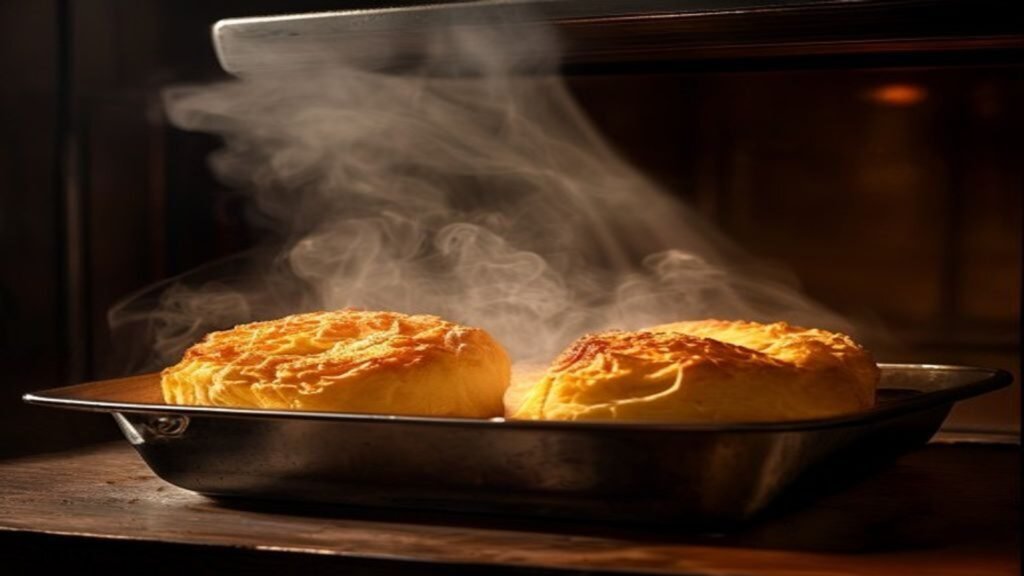
Almost every Yorkshire pudding recipe published in Britain says roughly the same thing, and almost every cook has had one collapse anyway. The reason is that recipes describe steps while the pudding obeys physics. Once you know what the batter is actually doing between the moment it hits the tin and the moment it comes out, the failures stop being mysterious.
What is actually happening
A Yorkshire pudding batter is flour, egg, milk and salt in roughly equal volumes of liquid and flour. It contains no raising agent. Everything that makes it rise is steam. When thin batter meets fat at around 220C, the water in the milk and egg converts to vapour almost instantly. That vapour has to go somewhere, and it pushes upward against a skin of egg protein and starch that is setting at the same moment. The pudding is, in effect, a bubble that cooked before it could burst.
This single fact explains the standard rules. The tin must be screaming hot, because slow heating produces steam gradually and gradually is useless. The fat must be smoking, because it transfers heat into the batter faster than air does. The oven door must stay shut, because a drop in temperature stops vapour production while the structure is still soft and the whole thing sags. And the batter must be thin, because a thick batter sets into cake before enough steam has formed to lift it.
The variables that matter
Resting the batter is the most argued-about step, and it does something real: it lets the flour hydrate fully and lets gluten formed by whisking relax. A rested batter is looser and rises more evenly. Half an hour at room temperature is enough; overnight in the fridge is fine but bring it back to room temperature first, because cold batter cools the tin.
Flour choice matters less than people claim. Plain flour is standard. Strong bread flour gives a taller, chewier pudding because more gluten means a stronger wall to hold the bubble. Either works. What does not work is self-raising flour, which produces a soft crumb rather than a hollow shell.
Fat choice changes flavour rather than mechanics. Beef dripping is traditional and tastes of the roast it accompanies. Sunflower or rapeseed oil behaves identically in the tin and has a higher smoke point, which makes it more forgiving. Butter burns. Olive oil burns and tastes wrong.
A method that works
Weigh rather than measure. Equal weights of egg, milk and plain flour, plus a good pinch of salt, is the most reliable ratio in domestic kitchens: for four large puddings, roughly 150g of each. Whisk until smooth, then leave it alone for thirty minutes.
Heat the oven to 230C, or 210C fan. Put a teaspoon of fat in each hole of a metal tin and give it ten minutes in the oven, until it shimmers and just begins to smoke. Pour the batter in fast, filling each hole about two thirds. Close the door. Twenty to twenty-five minutes without opening it. They are done when they are deep brown and rigid rather than merely risen, because pale puddings collapse as they cool.
Metal tins outperform silicone by a wide margin. Silicone insulates, which is exactly the wrong property. A cheap heavy steel tin will beat an expensive flexible one every time. Consumer testing by Which? on ovens and bakeware repeatedly finds that domestic ovens run several degrees off their dial, which is worth knowing if your puddings are consistently pale: an oven thermometer costs very little and solves the problem permanently.
Food safety and leftovers
Batter contains raw egg, so it should be kept refrigerated if you are resting it for more than an hour, and the Food Standards Agency guidance on eggs is the reference point if you are cooking for anyone vulnerable. Cooked puddings keep for a day in an airtight container and reheat well in a hot oven for three or four minutes. They freeze better than most people expect. They do not survive a microwave, which steams them into leather.
Why the tradition persists
The pudding began as a way of using dripping and filling stomachs before the meat arrived, served first with gravy so that less beef was needed. That original economic logic is visible in historical dietary records held by the National Archives, and it survived into modern cooking because it produces something disproportionately impressive from flour, egg and milk. A batter that costs pennies rises fifteen centimetres. Very little else in domestic cooking offers that ratio.
It is also, unusually for British cooking, a dish with an actual protected identity. Since 2020 the traditional forced rhubarb of West Yorkshire and other regional foods have held protected status; the Yorkshire pudding itself does not, which is why it is made in every county and argued about in all of them.
Related reading: what British growers harvest each month, how to read UK food date labels, and the rest of our food section.