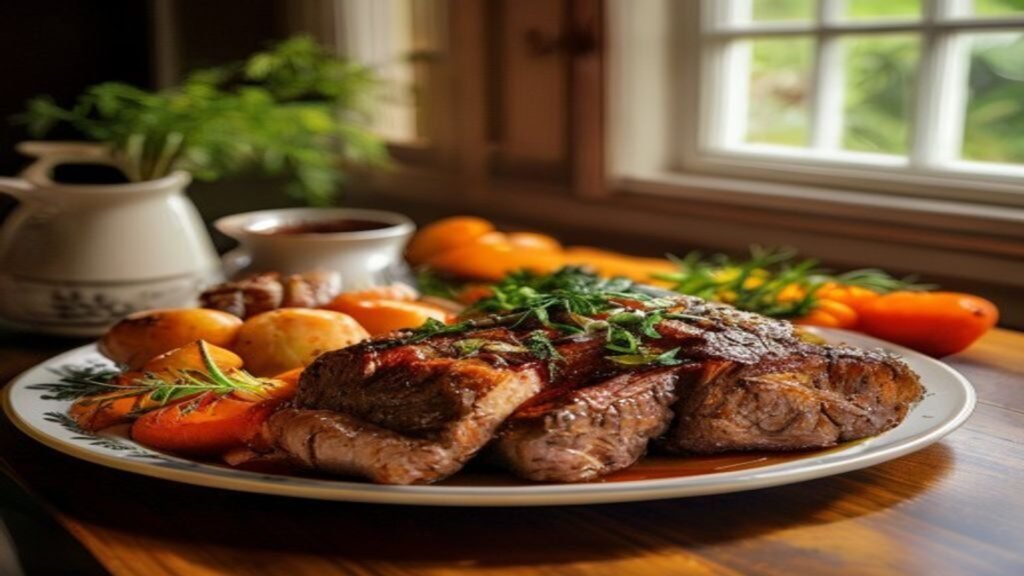
Almost every enduring national meal began as a practical solution to a problem, and the British roast dinner is no exception. It grew out of a working week in which Sunday was the one day the household was at home together and the one day the oven could be given over to a single large joint. The details have shifted repeatedly since then, but the shape of the meal has proved remarkably difficult to dislodge.
A meal built around the working week
The roast owes its timing to labour rather than to cookery. In industrial Britain, Sunday was the day when the mill, the mine or the factory was quiet, and the joint that had been bought on Saturday could be cooked slowly while the family was at church or at rest. In many towns the local baker took in joints from households without a large oven of their own, roasting them alongside the bread and returning them in time for the afternoon. What survived from that arrangement is the sense that the roast belongs to a specific hour of a specific day, and that lateness is a small offence against the household.
What is actually on the plate
The standard components settled into place gradually. Beef carries the greatest symbolic weight, to the point that the French nickname for the English derives from it, but chicken has quietly become the most commonly roasted meat in British homes because it is cheap, quick and forgiving. Lamb belongs to spring, pork to the colder months, and the vegetables follow the same seasonal logic even in an era when the supermarket has largely abolished the seasons. Potatoes are the non negotiable element, and the argument about how to achieve a crisp exterior and a floury interior is conducted with a seriousness usually reserved for sport.
Yorkshire pudding is a regional dish that escaped its region. It was originally cooked beneath the joint so that the batter caught the fat as it dripped, and it was eaten before the meat as a way of filling the stomach cheaply. That older order has largely vanished, but the pudding is now expected on plates far outside Yorkshire, and its absence is noticed. Our guide to making Yorkshire puddings that actually rise looks at the physics behind the batter in more detail.
The economics of eating out
The most significant change to the roast in the past three decades has been the migration of the meal from the home to the pub. Gastropub cooking made a virtue of a dish that many households were beginning to find too laborious for a weekend, and it created a price point at which a family could eat a recognisably traditional meal without spending the morning at the stove. Trade bodies representing hospitality have repeatedly identified Sunday lunch as the most reliably profitable service of the week, and figures from the Office for National Statistics on household spending show how much of the food budget has shifted from raw ingredients towards meals bought outside the home.
That shift has consequences for what the meal means. A roast cooked at home is an act of labour distributed across a household, usually unequally. A roast bought at a pub is a transaction, and it is judged by different standards: the crispness of the potatoes, the quality of the gravy, whether the vegetables were cooked to order or held in a warmer. Both versions are recognisably the same meal, and both are defended fiercely.
Waste, leftovers and thrift
The roast was designed to be eaten more than once. A joint large enough for Sunday produced cold meat for Monday, a pie or a hash later in the week and a stock from the bones. That thrift has weakened as portions have become more precisely calibrated, and food waste campaigners now spend a good deal of energy trying to reintroduce habits that were once simply assumed. Guidance from the Food Standards Agency on cooling, storing and reheating cooked meat safely is worth reading before the leftovers go into the fridge, particularly for households cooking a large joint for the first time. Our explainer on what food date labels actually mean covers the difference between the dates that matter for safety and the ones that do not.
Regional variation and quiet change
There is no single correct roast, whatever any given family believes. Stuffing appears in some households and not others. Cauliflower cheese is standard in parts of the country and regarded as an eccentricity elsewhere. Red cabbage, parsnips glazed with honey, pigs in blankets outside the Christmas period: each is orthodox somewhere. The meal has also absorbed change without appearing to. Roast dinners built around a nut roast, a whole roasted cauliflower or a mushroom based centrepiece are now common enough that most pubs list one, and the surrounding plate is identical.
Meat consumption in Britain has been falling slowly for years, particularly among younger adults, and the trade press has spent much of the past decade predicting the decline of the roast as a result. It has not happened. What appears to be occurring instead is a narrowing: fewer roasts, cooked or bought with more deliberation, treated as an event rather than as a default. That is arguably a return to the original logic of the meal, in which a joint of meat was expensive enough to require a reason.
Why it survives
The roast persists because it does something no other British meal reliably does, which is to require people to sit down at the same time. It cannot easily be eaten in front of a screen, it does not survive being staggered across an afternoon, and it is difficult to produce for one person without the result feeling melancholy. In a food culture that has otherwise moved decisively towards speed, portability and individual choice, that inconvenience is the point. More of our writing on how Britain eats can be found in the Food section, and readers interested in the produce behind the plate may want our month by month guide to British seasonal produce.
How the roast changed over time
The Sunday roast is often described as timeless, but the version most households recognise is comparatively recent, shaped by the spread of domestic ovens and by post-war changes in meat supply. The social history of communal eating and the buildings it happened in is documented extensively by Historic England, whose records on inns, kitchens and market halls trace how the meal moved from the hearth to the range. On the nutritional side, the balance of a traditional roast, particularly portion size and the proportion of vegetables to meat, maps closely onto the guidance in the NHS Eatwell advice. For a related read, see our guide to British seasonal produce.