
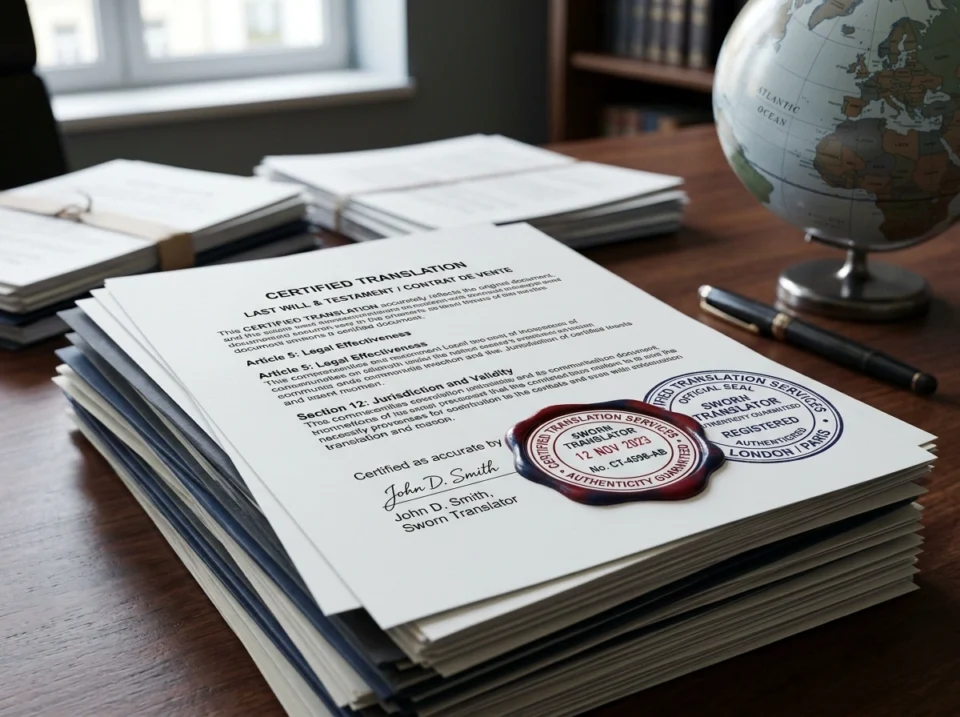
Have you ever read a contract and felt like it was written in a completely different language? Legal jargon is notoriously complex and difficult to digest. When you introduce an actual foreign language to the equation, the stakes multiply immediately. A single misunderstood term can change the entire meaning of a business contract, a birth certificate, or a court filing.
If you plan to submit foreign-language paperwork to a United States court, immigration office, or academic institution, standard translation simply will not cut it. Government bodies and large institutions demand strict proof of accuracy. They need absolute certainty that the English version of your document perfectly mirrors the original text.
This article explains the core components of certified translations and why they matter so much. You will learn how accurate language protects your legal rights, prevents costly delays, and keeps your personal data secure. We will also explore the severe risks of using uncertified professionals for your most sensitive and important paperwork.
The High Stakes of Accuracy in Legal Paperwork
Legal systems operate on absolute precision. Every clause, comma, and specific definition carries immense weight. If a translator misinterprets a phrase in a corporate merger agreement, it can lead to massive financial liabilities for the companies involved.
Standard bilingual speakers often lack the highly specific vocabulary needed to handle legal paperwork. Legal concepts in one country do not always have a direct equivalent in another country. A professional must understand the source language, the target language, and the unique legal frameworks of both nations.
Consider a divorce decree, a child custody agreement, or a last will and testament. If the translated document fails to capture the exact stipulations of the original text, the parties involved might accidentally violate a strict court order. Inheritances could be distributed incorrectly. Child custody rights could be compromised.
Accuracy is essentially the foundation of justice and compliance. Using certified translation services ensures that your documents reflect the exact legal intent of the original text, protecting you from devastating misunderstandings.
Gaining Legal Validity and Acceptance by Authorities
Institutions like the United States Citizenship and Immigration Services (USCIS) maintain incredibly strict guidelines for processing foreign documents. They will absolutely not accept a standard translated page. Instead, they require a formally signed Certificate of Accuracy.
This certificate acts as a legally binding declaration. The translator confirms their competency in both languages and swears that the translated text is complete and precise. Without this attached statement, government agencies will simply treat the document as invalid and ignore your application.
Courts, the Department of Motor Vehicles (DMV), and major universities hold similar, stringent standards. If you are applying for a green card, preparing for a naturalization interview, or seeking a student visa, your birth certificates and academic transcripts must meet these federal requirements.
Some agencies and financial institutions even require notarization on top of the standard certification. In these cases, a state-commissioned notary public witnesses the translator signing the certificate. This process adds an extra layer of legal authentication, which is often required for civil and criminal court proceedings across all fifty states.
The Costly Risks of Uncertified Translations
Taking shortcuts with official legal translations almost always backfires. Many people try to save money by asking a bilingual family member to translate their paperwork. Others rely on free automated software or cheap internet applications. These methods expose you to significant, avoidable dangers.
First, your application will likely face immediate rejection. If you submit an uncertified background check or birth certificate to USCIS, the agency will pause your case. They will issue a formal Request for Evidence (RFE). This action halts your immigration process and can delay your visa approval by several months.
Second, inaccurate translations can lead to severe legal penalties. If a state court discovers that a translated deposition contains major errors, the judge might throw out the evidence entirely. Your entire legal defense could collapse based on a few mistranslated sentences.
Finally, fixing these avoidable mistakes costs far more than hiring a professional from the start. You will lose your original application fees. You will miss crucial filing deadlines. You will also spend extra money rushing a proper, certified translation at the very last minute to salvage your case.
The Crucial Role of Professional Translators
Professional translators do much more than simply swap words from one language to another. They act as vital cultural and legal bridges between different nations. These human experts spend years studying legal terminology and staying updated on the latest regulatory changes in various jurisdictions.
Organizations like the American Translators Association (ATA) set exceptionally high ethical and professional standards for these linguists. When you hire an ATA-affiliated translation company, you receive documents completed by vetted, native-speaking experts. These professionals know exactly how to format the translated document so that judges and immigration officers can read it easily.
Confidentiality is another massive factor to consider. Legal documents often contain highly sensitive personal data. Medical records, tax returns, bank statements, and criminal background checks require strict privacy handling. Professional translation companies utilize secure online portals and enforce strict privacy policies to protect your sensitive information. A random freelance worker or an open-source artificial intelligence tool simply cannot guarantee that necessary level of data security.
Frequently Asked Questions About Certified Translations
To help you better understand this essential service, here are clear answers to some of the most common questions about legal document translation.
What exactly is a certified translation?
A certified translation is a formally translated document accompanied by a signed and dated Certificate of Accuracy. The professional translator or the translation agency provides this specific document to verify that the work is a complete and precise rendering of the original file.
Does USCIS require certified translations?
Yes. USCIS requires certified translations for any foreign-language document submitted with an application or formal filing. The translation must comply completely with federal regulations, specifically USCIS requirements for accuracy and completeness.
Can I translate my own legal documents?
No. Even if you are completely fluent in both the source and target languages, government bodies do not allow applicants to translate their own paperwork. You must use a competent, independent third-party translator who can formally certify the document.
How fast can I get a legal document translated?
Turnaround times vary based on the total length and the complexity of the text. However, many professional services complete standard documents, like birth certificates and marriage licenses, in just one to three business days. Rush services are also widely available for urgent court dates or impending immigration deadlines.
What is the difference between an apostille and a certified translation?
A certified translation purely verifies the accuracy of the translated text. An apostille is a specific government-issued authentication that verifies the legal authenticity of the original document itself for international use under the Hague Convention. Some international legal processes require both services.
Why can I not just use artificial intelligence for my legal translation?
Artificial intelligence struggles heavily with the nuanced context of legal language. Machines frequently mistranslate highly specific legal terminology, which can completely alter a document’s meaning. Furthermore, feeding confidential legal documents into public artificial intelligence models poses a massive security risk to your personal data.
Protect Your Case with Professional Language Expertise
Navigating the legal system is stressful enough without constantly worrying about language barriers. Proper, accurate documentation forms the firm foundation of any successful court case, corporate business merger, or complex immigration application.
Do not let a simple translation error jeopardize your future. By hiring certified language professionals, you guarantee that your paperwork meets all official guidelines and passes strict legal scrutiny.
If you need to submit foreign-language documents to a United States court, university, or government agency, secure your peace of mind today. Reach out to a reliable, certified translation provider to get an accurate quote and keep your legal process moving forward as smoothly as possible.
