
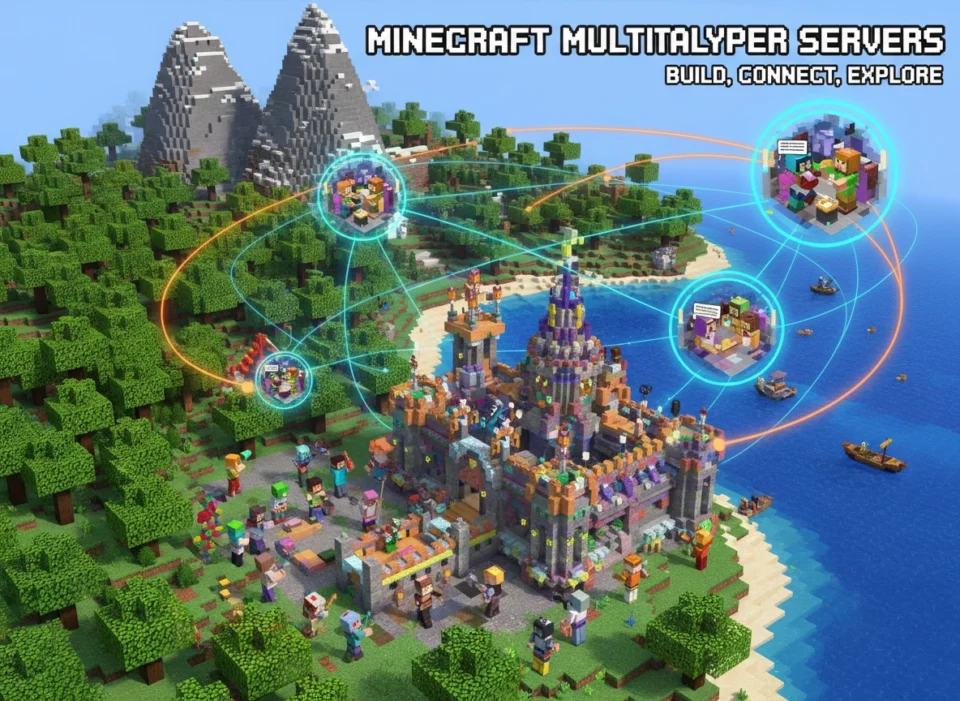
Minecraft began as a simple project about placing and breaking blocks in a solitary world. Today, it stands as a massive cultural phenomenon. When we look at the extraordinary success and longevity of this game, we must point to the backbone of its multiplayer experience: the servers. Minecraft servers transformed a solitary survival game into a bustling digital universe. They foster community, enable boundless creativity, and fundamentally enhance the multiplayer experience.
Through player-run networks, the game evolved far beyond its original code. Let us explore the history, technical foundations, diverse varieties, and broader industry impact of Minecraft servers to understand their true role in multiplayer gaming.
The Evolution: A Brief History of Minecraft Servers
The story of Minecraft multiplayer is a story of community ingenuity. In the earliest days of the game, multiplayer was a bare-bones experience. Players had to set up port forwarding on their home internet routers just to let a few friends join their local worlds. It was clunky, often laggy, and prone to crashing.
However, as the player base grew, so did the demand for stable, always-online worlds. Enthusiasts began renting dedicated server space to host their games 24/7. Soon, community developers stepped in to fill the gaps left by the base game. They created custom software wrappers like Bukkit, which allowed server owners to install plugins. These plugins fundamentally changed how multiplayer functioned, adding permissions, land protection, and custom game modes.
What started as small, private worlds for groups of friends quickly expanded. By 2012 and 2013, we saw the rise of mega-servers. These networks could hold thousands of concurrent players. They introduced hub systems, connecting multiple different servers together so players could seamlessly travel between different game modes. This evolution shifted the power of game design directly into the hands of the players, turning server administrators into amateur game developers.
Under the Hood: Technical Aspects of Running a Server
Running a successful Minecraft server requires more than just launching the game and inviting friends. It demands a solid understanding of networking, hardware allocation, and software management. At its core, a server is simply a computer running the Minecraft server application. However, to support hundreds or thousands of players, the technical requirements scale dramatically.
The most critical resource for a Minecraft server is RAM (Random Access Memory), followed closely by single-core CPU performance. Because the game relies heavily on processing chunk generation, entity movements, and redstone calculations, a weak processor will quickly cause the server to lag. When server ticks—the heartbeat of the game loop—drop below 20 per second, players experience delayed block breaking, rubber-banding, and a frustrating experience.
To combat these performance bottlenecks, the community developed highly optimized server software. Projects like Spigot and Paper modified the base code to run more efficiently. These platforms also provide the API (Application Programming Interface) necessary for plugins.
Server administrators use plugins to manage almost every aspect of the player experience. They set up chat filters, anti-cheat systems, automated server restarts, and complex economy databases. Furthermore, modern large-scale servers use proxy software like BungeeCord or Velocity. These tools act as a gateway, routing players across dozens of smaller, interconnected servers behind the scenes. This prevents any single machine from taking on too much load, allowing server networks to scale almost infinitely.
A World for Everyone: Types of Minecraft Servers
One of the greatest strengths of Minecraft multiplayer is its sheer variety. Because the community dictates the rules, you can find a server tailored to almost any playstyle. This variety keeps the game fresh and engaging year after year.
Survival and Factions
Survival servers offer the classic Minecraft experience but on a massive scale. Players gather resources, build shelters, and survive against monsters, all while interacting with a broader economy. A popular spin-off of this is Factions. In Factions servers, players form clans, claim territory, and engage in large-scale PvP (Player versus Player) warfare. They build massive obsidian bases and use TNT cannons to breach enemy walls. It is a highly competitive environment that requires teamwork, strategy, and resource management.
Creative and Building
For those who prefer a peaceful experience, Creative servers provide infinite resources and a safe space to build. Often using a “plot” system, these servers assign each player a designated square of land. Players can build elaborate castles, modern cities, or pixel art without worrying about gathering materials or fighting off creepers. These servers often host building competitions and serve as a portfolio for talented digital architects.
Mini-games and Hubs
Mini-game servers completely re-imagine what Minecraft can be. Instead of surviving or building, players compete in short, fast-paced games. Popular modes include BedWars, where teams protect a bed while trying to destroy their opponents’ beds, and SkyWars, where players battle on floating islands. These massive hub servers feel more like digital theme parks than traditional survival games. They feature custom resource packs, intricate lobby designs, and leveling systems that keep players coming back for more.
Roleplay and Modded
Roleplay servers enforce strict rules where players must act out specific characters, such as citizens in a medieval kingdom or students in a magical academy. Meanwhile, modded servers require players to download external modifications that add completely new items, machines, and magic systems to the game. These servers offer an entirely different progression system, turning Minecraft into complex industrial simulators or high-fantasy RPGs.
Fostering Community and Enabling Creativity
Beyond the technical achievements and varied game modes, the true significance of Minecraft servers lies in the communities they build. Servers act as virtual third places—social environments distinct from home and school or work. Friendships forge across continents as players collaborate on massive projects or defend their bases together.
Servers force players to communicate, negotiate, and work together. When you join a towny server, you must collaborate with your neighbors to manage resources and build infrastructure. When you join a building team, you learn how to coordinate architectural styles and manage a large-scale project. These interactions teach valuable social and leadership skills.
Furthermore, servers are ultimate engines of creativity. They give players a canvas and an audience. A beautiful build in a single-player world is seen by one person. A beautiful build on a busy server becomes a landmark enjoyed by thousands. This shared experience motivates players to push the boundaries of what the game’s simple block engine can achieve.
The Broader Impact on the Gaming Industry
The success of Minecraft servers left a permanent mark on the broader video game industry. Before Minecraft, multiplayer gaming was largely controlled by game studios. Developers hosted the servers, dictated the game modes, and tightly controlled the experience.
Minecraft proved that handing the keys over to the community could result in an unprecedented level of engagement. It showed that player-generated content and community-run networks could sustain a game for over a decade. This success influenced a whole new generation of games. We see the DNA of Minecraft servers in platforms like Roblox, where user-created games are the core product, and in survival games like Rust and ARK, which rely heavily on community-hosted dedicated servers.
Additionally, Minecraft servers created an entirely new micro-economy. Server hosting companies emerged to provide affordable hardware to players. Talented plugin developers and professional builders began charging for their services. Server owners themselves found ways to monetize their networks through VIP ranks and cosmetic items. While this occasionally led to friction regarding monetization rules, it undeniably proved that gaming communities could operate as self-sustaining businesses.
Conclusion
Minecraft servers are much more than a method for connecting players; they are the lifeblood of the game. From their humble beginnings as clunky port-forwarded worlds to the massive, interconnected networks we see today, servers showcase the incredible power of community-driven development.
They provide a space for every type of player, whether you want to engage in competitive combat, build architectural masterpieces, or simply chat with friends. By fostering robust communities and enabling limitless creativity, Minecraft servers transformed a simple sandbox game into an enduring digital ecosystem. They forever changed our expectations of what multiplayer gaming can achieve, proving that when you give players the right tools, they will build entirely new worlds.
Please visit website for more info.
